
Drug Trend 2025 and What It Means for Your Plan
One thing that’s obvious about our annual Drug Trend Report is that every year tells a different story, and no two reports look the same. Continual shifts in utilization, therapies and market pressures are always reshaping trend, and historical context matters. But key to the bigger picture behind drug trend is clarity – knowing exactly where the money is going and why. Thanks to our full decade of in-depth reports, we can show how patterns evolve, while the year-over-year comparisons help us and our partners plan. In this blog, we’ll dig into why 2025 stands out so much.
A Preview of the 2025 Drug Trend Report
As explained in our 10th annual Drug Trend Report by some of our Navitus subject matter experts:
Specialty drug trend rose 11.1% last year, driven almost entirely by a 13.1% increase in utilization but offset by a 1.9% decrease in unit cost.
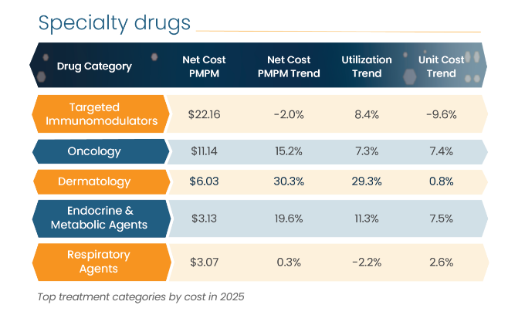
However, we did see unit cost decreases due to the launch of the biosimilar ustekinumab. But there’s no question that specialty drug cost remains the biggest source of plan risk and uncertainty. It demands decisive, evidence-based management.
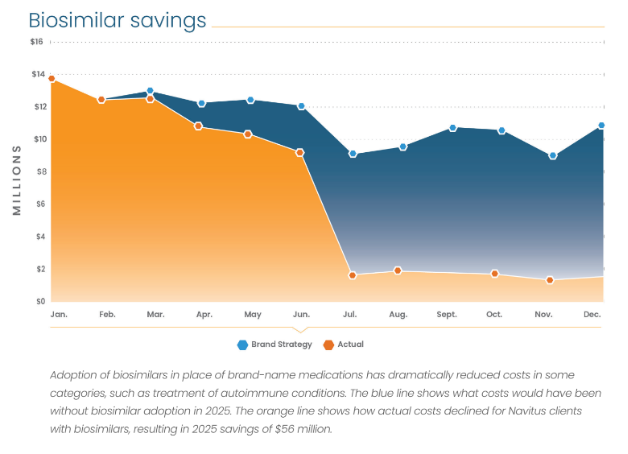
While biosimilar adoption is making a dent in the total costs, the continued influence of specialty on overall trend is enormous, with a small number of therapies driving disproportionate spend.
See how else 2025 was different by checking out the Drug Trend Report.
How We Report Trend Continues to Evolve
It’s been said that you can make statistics work for whatever point you’re trying to get across. But what if your point is to be as transparent as possible?
Clarity is our company’s promise, so instead of summarizing trend numbers, we provide the context that explains trend drivers, then give the results tied to them. Over the last decade, we’ve continually refined how we present our data to do exactly that, offering our partners more focus, clarity and context:
- By cutting through the clutter of standard reports, we’re able to prioritize sharing what drives decisions in the pharmaceutical industry.
- We also overlay those annual results to identify both long-term patterns and the most likely future state, so we can be proactive for our partners instead of reactive.
- By focusing on better reporting, the data we deliver becomes more useful.
Which all leads into our action-oriented structuring of insights, helping plan sponsors understand exactly how they can apply that thinking.
As a Senior Clinical Consultant Pharmacist at Navitus, Imke Scheepers, nicely sums it up, “Where we stand in 2025 is the product of both innovation and volatility. For plan sponsors and health plans, the decade ahead will require even sharper insight, faster action and a pharmacy benefit manager (PBM) partner delivering clarity, innovation and expertise. Navitus remains committed to delivering exactly that.”
Why These Shifts Matter
So the clutter is cut, the data is clear and the future is a little more predictable. How does that help payers in their everyday business?
In a word: control.
By knowing where spend is concentrated, we can implement targeted strategies for plan sponsors, giving their decisions stronger impact in the long run. By better understanding the drivers at work, we can help plan sponsors look ahead confidently and forecast potential issues, adjusting strategies as needed. And these improved decision-making capabilities drive plan design and management, meaning fewer surprises and better, faster reactions when trends shift.
Get a clear look at how we present the data by downloading our 10th annual Drug Trend Report.
Stay Informed and Connected
Receive expert insights, healthcare tips, and important updates on pharmacy benefits, drug recalls, and more—straight to your inbox.
CLARITY FOR ACTION
Gain Clarity: Navitus 10th Annual Drug Trend Report Ready to Download
Our 2025 report provides transparent, data-driven insight to help plans, plan sponsors and consultants navigate an increasingly complex prescription drug landscape.
Related blogs
Navigating Healthcare and Improving Outcomes

Don’t Sign Here – The 7 Red Flags of PBM Contracts
Signing with a new pharmacy benefit manager (PBM) can be a daunting experience, with hundreds or thousands of plan members depending on that choice. And in this opaque industry, it is important to look beyond the initial conversations with a PBM when…


